
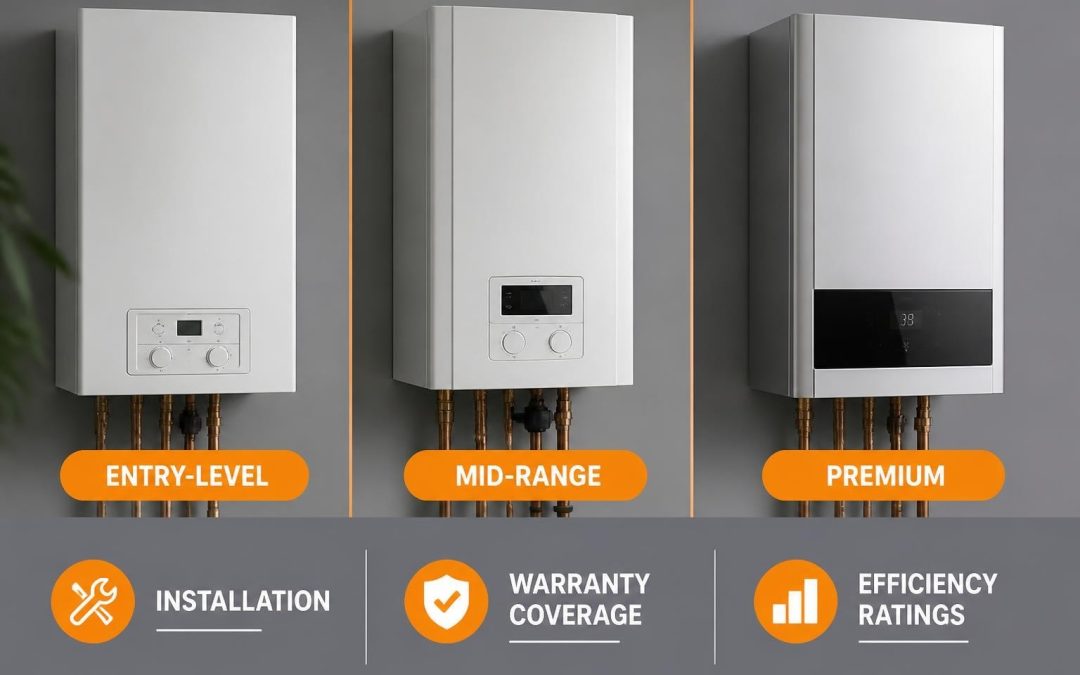
Understanding the true cost of a system boiler involves more than just the unit price. Homeowners across the North East and throughout the UK face a complex landscape of brands, models, efficiency ratings, and installation variables that all influence the final investment. Whether you're replacing an ageing system or upgrading to improve efficiency, gaining clarity on system boiler prices helps you budget accurately and make informed decisions that balance upfront costs with long-term savings.
Understanding System Boiler Pricing Components
System boiler prices vary considerably based on several interconnected factors that determine both initial outlay and ongoing operational costs. The boiler unit itself represents just one portion of your total investment.
Boiler Unit Costs by Output Rating
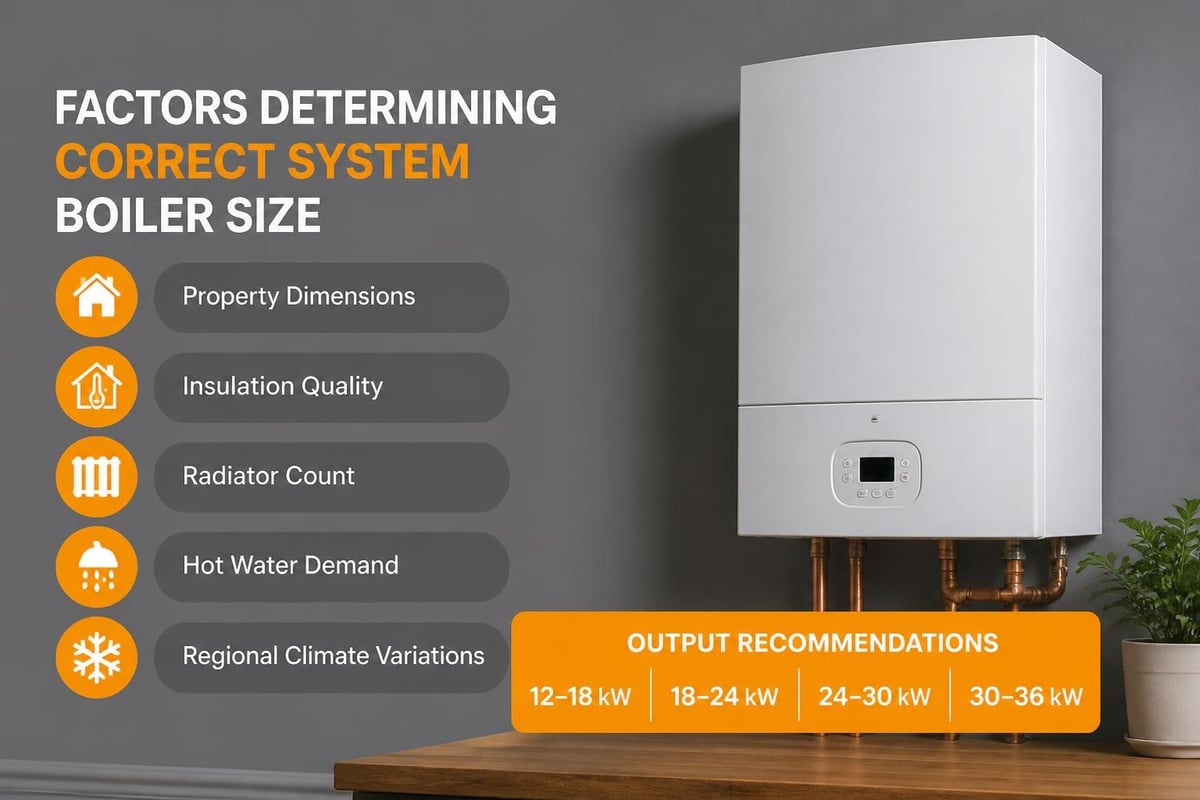
The kilowatt (kW) output rating significantly influences pricing, as larger properties with greater heating demands require more powerful units. Entry-level system boilers typically start around £600 for basic 12-15 kW models, whilst mid-range options between 18-25 kW generally cost £800-£1,500. Premium models with outputs exceeding 30 kW can reach £2,000-£3,000 for the unit alone.
Popular output ratings include:
- 12-15 kW for smaller homes (2 bedrooms, 1 bathroom)
- 18-24 kW for medium properties (3 bedrooms, 1-2 bathrooms)
- 25-35 kW for larger homes (4+ bedrooms, multiple bathrooms)
Different manufacturers position their products at varying price points, with budget-friendly brands offering reliable performance whilst premium manufacturers provide extended warranties and advanced features.
| Output Range | Budget Models | Mid-Range Models | Premium Models |
|---|---|---|---|
| 12-15 kW | £600-£800 | £900-£1,200 | £1,300-£1,800 |
| 18-24 kW | £750-£950 | £1,000-£1,400 | £1,500-£2,100 |
| 25-35 kW | £900-£1,200 | £1,300-£1,800 | £1,900-£3,000 |
The comprehensive overview of system boiler functionality demonstrates how these heating systems store hot water in separate cylinders, making them ideal for homes with multiple bathrooms.
Installation Costs and Labour Considerations
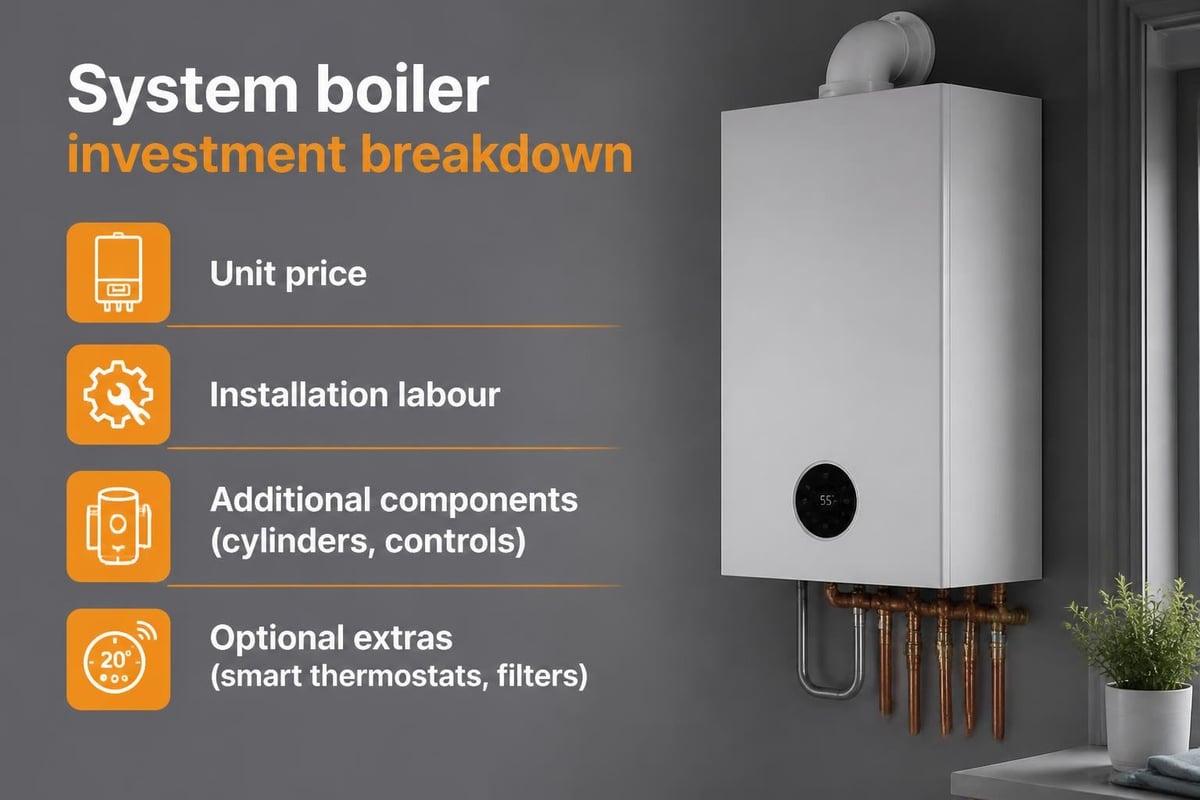
Installation expenses often exceed the boiler unit cost, particularly when upgrading from a different boiler type or relocating the system. Professional installation ensures safety, compliance with Building Regulations, and optimal performance.
Labour costs across the North East typically range from £500-£1,500 depending on complexity. A straightforward like-for-like replacement represents the most economical option, whilst converting from a conventional to a system boiler involves additional pipework modifications and cylinder installation.
Installation complexity factors:
- Existing system type and compatibility
- Boiler location and accessibility
- Required pipework modifications
- Cylinder installation or replacement
- Control system upgrades
- Flue repositioning or replacement
Time requirements influence labour costs substantially. Simple replacements may complete within one day, whereas complex installations requiring extensive pipework alterations can extend to three or four days. Our plumbing and central heating expertise ensures efficient installations that minimise disruption.
Additional Component Costs
Beyond the boiler and labour, several essential components contribute to overall system boiler prices. Hot water cylinders represent a significant expense, with basic indirect cylinders starting around £200-£400 and premium stainless steel models with enhanced insulation reaching £600-£1,200.
Modern heating controls improve efficiency and convenience. Programmable thermostats cost £80-£200, whilst smart controls with smartphone connectivity range from £150-£300. Magnetic filters protect your system from sludge buildup, costing £100-£150 plus fitting.
Brand Comparison and Value Analysis
Different manufacturers occupy distinct market segments, balancing affordability, reliability, and feature sets. Understanding brand positioning helps identify which offers best value for your specific requirements.
Budget-Friendly Options
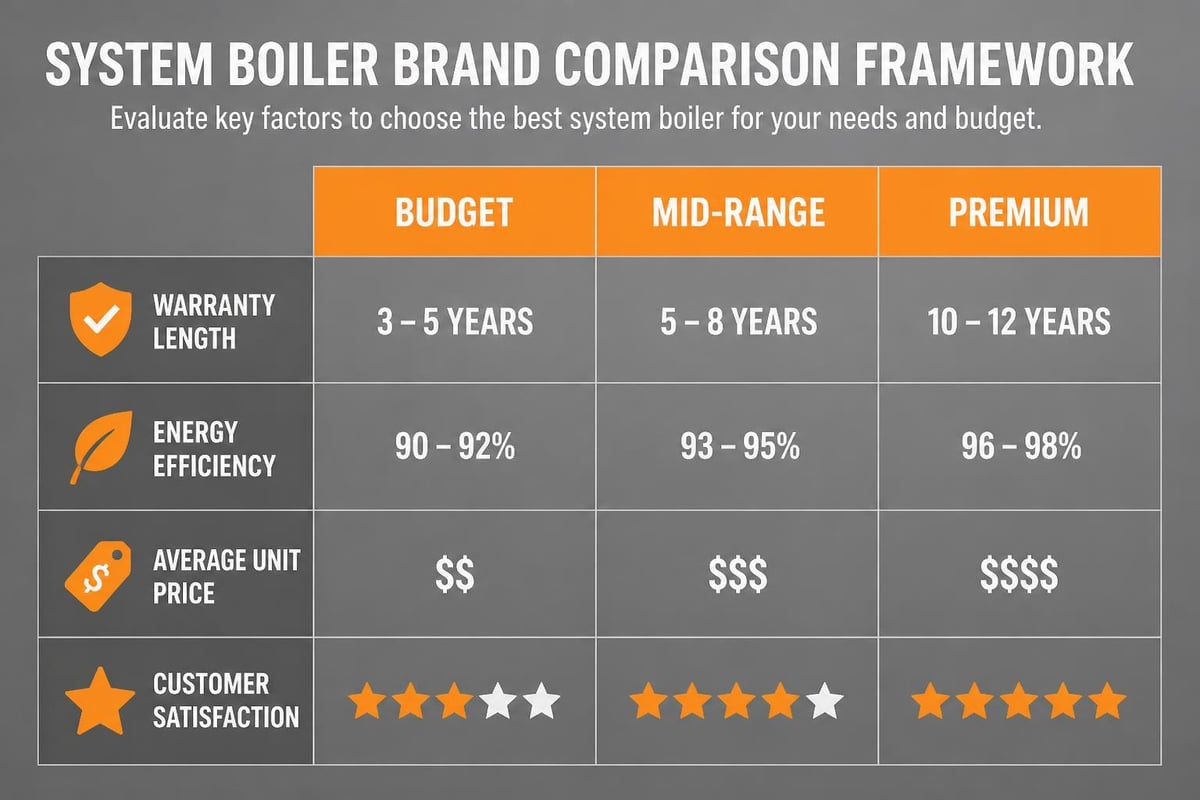
Entry-level brands deliver dependable performance at accessible price points. These manufacturers typically offer 2-5 year warranties and focus on essential functionality without premium features. Complete installations including standard components usually total £1,800-£2,500.
Ideal for landlords, first-time buyers, or those requiring temporary solutions, budget options provide heating security without excessive investment. The detailed analysis of system boiler costs highlights various models across price ranges.
Mid-Range Market Leaders
Established British and European manufacturers dominate this segment with proven track records and 5-7 year warranties. System boiler prices for these models typically position complete installations between £2,500-£3,800.
These brands balance affordability with advanced features like weather compensation, smart controls compatibility, and quieter operation. Many homeowners find this segment offers optimal value, combining reliability with reasonable pricing.
| Brand Category | Typical Unit Price | Warranty Period | Installation Total |
|---|---|---|---|
| Budget | £600-£900 | 2-5 years | £1,800-£2,500 |
| Mid-Range | £900-£1,500 | 5-7 years | £2,500-£3,800 |
| Premium | £1,500-£3,000 | 7-12 years | £3,500-£5,500 |
Premium Manufacturer Offerings
Top-tier brands command higher system boiler prices through superior build quality, extended warranties up to 12 years, and advanced technology. Complete installations commonly exceed £3,500 and can reach £5,500 for larger outputs with comprehensive control packages.
Premium manufacturers invest heavily in research and development, producing highly efficient units with sophisticated modulation capabilities that adapt precisely to heating demands. These systems often operate more quietly and require less maintenance over their lifespan.
Efficiency Ratings and Running Costs
Modern system boilers achieve impressive efficiency ratings that directly impact long-term operating expenses. Understanding the relationship between initial investment and ongoing costs provides clearer perspective on true value.
ErP Efficiency Classifications
All boilers display Energy-related Products (ErP) labels rating seasonal efficiency from A+++ to G. Modern system boilers typically achieve A-rated status, converting 90-94% of fuel into usable heat. Some premium models reach A+ efficiency levels exceeding 94%.
Higher efficiency reduces gas consumption and lowers energy bills. A household spending £1,200 annually on heating with an old G-rated boiler (70% efficiency) could reduce costs to approximately £900 with an A-rated system boiler, saving £300 yearly.
Annual savings potential:
- Upgrading from G-rated (70% efficiency): £300-£400 reduction
- Upgrading from E-rated (78% efficiency): £180-£250 reduction
- Upgrading from C-rated (86% efficiency): £70-£100 reduction
The comprehensive guide to boiler pricing examines how efficiency ratings influence both purchase decisions and long-term expenses.
Condensing Technology Benefits
All modern system boilers incorporate condensing technology that recovers heat from exhaust gases, dramatically improving efficiency compared to non-condensing models. This technology contributes to system boiler prices but delivers substantial operational savings.
Condensing systems require appropriate drainage for acidic condensate, occasionally necessitating additional installation work. However, the efficiency gains typically recover these costs within 3-5 years through reduced fuel consumption.
Finance Options and Budget Planning
Spreading costs through finance arrangements makes system boiler installation accessible whilst preserving capital for other priorities. Various payment structures accommodate different financial situations.
Interest-Free Finance Schemes
Many heating installers, including ourselves, now offer 0% finance options that divide total costs into manageable monthly payments without additional charges. These schemes typically require a deposit and spread the balance over 12-60 months depending on the arrangement.
For a £3,000 installation paid over 36 months interest-free, monthly payments would total approximately £83. This approach enables homeowners to upgrade to more efficient systems without depleting savings.
- Assess total installation cost including all components
- Determine affordable monthly payment amount
- Calculate suitable repayment period
- Apply for finance approval
- Schedule installation upon acceptance
Government Schemes and Grants
Various initiatives help eligible homeowners reduce system boiler prices through financial assistance. The Boiler Upgrade Scheme primarily targets heat pumps but understanding renewable energy heating systems helps evaluate all options.
Local authority schemes occasionally offer grants for low-income households or those in fuel poverty. Energy Company Obligation (ECO) programmes may provide support for qualifying homeowners replacing inefficient systems.
Sizing Your System Boiler Correctly
Selecting appropriate output capacity prevents overspending on oversized units whilst ensuring adequate heating and hot water provision. Professional heat loss calculations determine precise requirements.
Undersized boilers struggle to meet demand, particularly during cold weather, whilst oversized units cost more initially and cycle frequently, reducing efficiency and component lifespan. System boiler prices increase with output, making accurate sizing economically important.
Sizing considerations include:
- Property size and insulation levels
- Number of radiators and their heat output
- Hot water cylinder capacity
- Simultaneous hot water draw-offs
- Future extension plans
A qualified heating engineer performs room-by-room heat loss calculations accounting for wall construction, glazing quality, ventilation rates, and regional climate factors. This scientific approach ensures optimal sizing.
Cylinder Selection and Integration
System boilers require separate hot water cylinders, with capacity and quality significantly influencing both performance and system boiler prices overall.
Cylinder Capacity Options
Cylinder sizes range from 120 litres for smaller households to 300+ litres for larger families with high hot water demands. A typical three-bedroom home with one bathroom usually requires 180-210 litres, whilst properties with multiple bathrooms benefit from 250-300 litre cylinders.
Larger cylinders cost more but prevent hot water shortages during peak usage periods. The selection of system boilers from reputable suppliers demonstrates how proper component matching optimises system performance.
Premium Cylinder Features
Basic indirect cylinders meet essential requirements economically, whilst premium options incorporate enhanced insulation, faster recovery rates, and superior longevity. Stainless steel cylinders resist corrosion better than copper alternatives, particularly in hard water areas.
High-performance insulation maintains water temperature longer, reducing reheating frequency and lowering energy consumption. Some cylinders include dual coils enabling integration with solar thermal panels for further efficiency gains.
| Cylinder Type | Capacity Range | Price Range | Key Benefits |
|---|---|---|---|
| Basic Indirect | 120-250L | £200-£400 | Economical, reliable |
| Enhanced Insulation | 150-300L | £350-£600 | Better heat retention |
| Stainless Steel | 180-400L | £600-£1,200 | Corrosion resistant |
| Solar Compatible | 200-300L | £700-£1,400 | Renewable integration |
Ongoing Maintenance and Warranty Considerations
Annual servicing preserves efficiency, prevents breakdowns, and maintains warranty validity. Service costs typically range from £80-£120, representing sound investment in system longevity.
Manufacturer warranties provide security against component failures, with coverage duration varying considerably. Basic warranties offer 2-5 years parts and labour, mid-range brands provide 5-7 years, whilst premium manufacturers extend coverage to 10-12 years.
Extended warranties sometimes accompany professional installation, with manufacturers requiring Gas Safe registered engineers to validate coverage. Always verify warranty terms before finalising purchase decisions.
Warranty considerations:
- Coverage duration and what's included
- Registration requirements and deadlines
- Annual servicing stipulations
- Excess or call-out charges
- Transferability to new property owners
Regular maintenance identifies minor issues before they escalate into expensive repairs. Well-maintained system boilers frequently exceed their expected 15-year lifespan, maximising return on investment.
Regional Price Variations Across the UK
System boiler prices fluctuate geographically due to labour costs, competition levels, and regional demand patterns. Understanding local market conditions helps identify competitive pricing.
The North East typically experiences slightly lower installation costs compared to London and the South East, where labour rates command premium pricing. However, rural areas sometimes face higher charges due to travel time and limited installer availability.
Obtaining multiple quotations from reputable local installers ensures competitive pricing whilst supporting regional businesses. The detailed explanation of system boiler suitability helps homeowners evaluate whether this boiler type matches their requirements.
Hidden Costs and Unexpected Expenses
Budgeting for potential additional expenses prevents financial surprises during installation. Several scenarios may increase final costs beyond initial quotations.
Asbestos discovery around old boilers requires specialist removal, adding £500-£2,000 depending on extent. Upgrading gas supply pipes to meet current regulations costs £300-£800. Chimney lining for balanced flue installations adds £400-£1,000.
Potential additional costs:
- Asbestos removal (£500-£2,000)
- Gas pipe upgrades (£300-£800)
- Chimney modifications (£400-£1,000)
- Electrical work (£150-£400)
- Radiator replacement (£100-£300 each)
- System cleansing (£350-£500)
Power flushing removes accumulated sludge and debris, recommended when installing new boilers into older systems. This process costs £350-£500 but prevents premature component failure and maintains efficiency.
Smart Controls and Heating Optimisation
Modern control systems maximise efficiency and convenience whilst incrementally increasing system boiler prices. These investments typically recover costs through reduced energy consumption within 2-4 years.
Smart thermostats learn household patterns, automatically adjusting heating schedules for optimal comfort and efficiency. Remote smartphone control enables temperature adjustments from anywhere, preventing energy waste when plans change unexpectedly.
Weather compensation systems adjust output based on external temperatures, maintaining consistent internal comfort whilst minimising fuel consumption. These sophisticated controls suit system boilers particularly well due to their modulating capabilities.
The comprehensive cost analysis for new boilers explores how control upgrades influence both initial investment and operational expenses.
System Boiler Versus Alternative Technologies
Comparing system boiler prices against combination and conventional boilers clarifies which technology delivers best value for specific circumstances.
Combination boilers eliminate separate cylinders, reducing installation complexity and costs for smaller properties. However, they struggle meeting simultaneous hot water demands in larger homes with multiple bathrooms.
Conventional boilers require both cold water tanks and cylinders, occupying more space but offering excellent performance in properties with low water pressure. System boilers represent a middle ground, combining conventional boiler benefits with space efficiency.
| Boiler Type | Installation Cost | Space Required | Hot Water Performance | Ideal Property Size |
|---|---|---|---|---|
| Combination | £1,500-£3,500 | Minimal | Limited simultaneous | 1-2 bedrooms |
| System | £2,000-£5,000 | Moderate | Excellent capacity | 2-5 bedrooms |
| Conventional | £2,200-£5,500 | Substantial | Outstanding | 4+ bedrooms |
Maximising Value From Your Investment
Strategic decision-making optimises return on investment whilst avoiding unnecessary expenditure on features providing limited benefit for your specific circumstances.
Matching boiler output precisely to requirements prevents overspending on excessive capacity. Selecting mid-range brands with proven reliability typically delivers better long-term value than either budget or premium alternatives.
Timing installations during quieter periods may secure preferential pricing from installers managing workload fluctuations. Summer installations often cost less than emergency winter replacements when demand peaks.
Value optimisation strategies:
- Obtain three quotations from reputable installers
- Choose appropriate rather than maximum specifications
- Consider total cost of ownership, not just purchase price
- Leverage finance options to access better equipment
- Schedule installation during off-peak periods
- Verify all warranty terms before committing
The detailed comparison of system boiler models assists homeowners evaluating options within specific budget parameters.
Quality Installation: The Critical Factor
Professional installation quality fundamentally influences system performance, efficiency, and longevity. Cutting costs through inexperienced installers frequently proves economically detrimental.
Gas Safe registered engineers possess essential qualifications and insurance coverage. Verify registration status independently rather than relying solely on installer claims. Request references from recent customers and examine completed work quality where possible.
Proper system design, accurate pipe sizing, appropriate expansion vessel selection, and thorough commissioning separate excellent installations from adequate ones. These details significantly impact long-term reliability despite adding minimal installation time.
Building Regulations compliance ensures safety and may affect property insurance and resale value. Non-compliant installations create legal liabilities and expensive rectification requirements.
Making Your Final Decision
Evaluating system boiler prices requires balancing immediate affordability against long-term value, matching specifications to genuine requirements, and selecting reputable installers committed to quality workmanship.
Consider total ownership costs over expected lifespan rather than focusing exclusively on initial outlay. A premium boiler with 12-year warranty and superior efficiency may ultimately cost less than a budget alternative requiring replacement within 8 years.
Prioritise essential features whilst avoiding expensive additions providing marginal benefits. Smart controls justify their cost through tangible savings, whilst aesthetic casings rarely warrant significant price premiums.
Research thoroughly, obtain detailed written quotations specifying all components and labour, and verify installer credentials before committing. Understanding specific brand pricing structures helps evaluate whether quotations represent fair value.
Understanding system boiler prices empowers informed decision-making that balances immediate investment with long-term performance and reliability. Whether you require straightforward replacement or complete system upgrade, professional guidance ensures optimal outcomes. Since 1983, NU Heat North East Ltd has delivered expert heating installations throughout the North East, combining technical expertise with transparent pricing and flexible 0% finance options. Contact our Newbiggin-by-the-Sea team today to discuss your requirements and receive a comprehensive quotation tailored to your property and budget.